
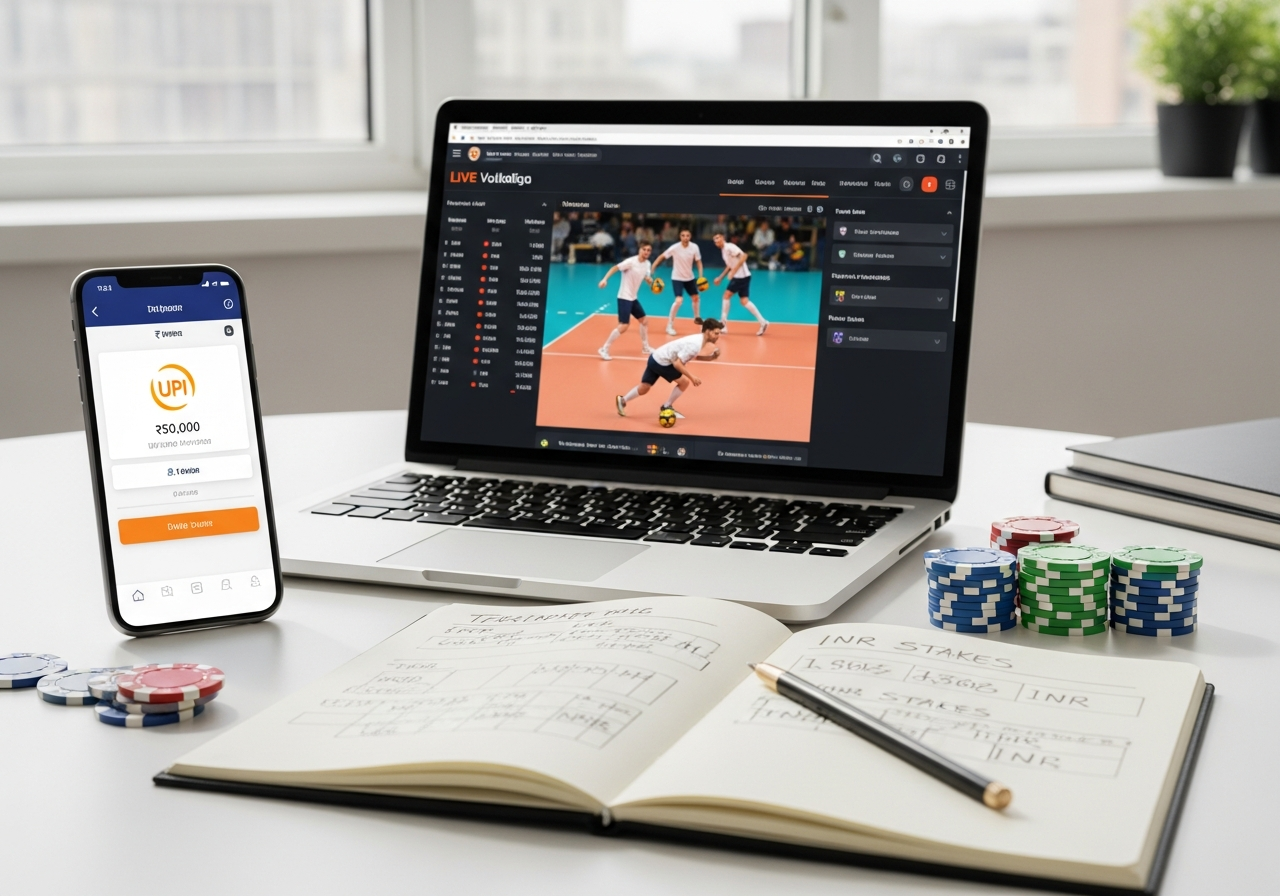
Volleyball has surged in popularity across India, driven by thrilling Olympic performances and global tournaments that captivate millions of fans. If you’re eager to turn that passion into wagered predictions, this guide will walk you through every step of betting on volleyball matches from India. Whether you’re placing your first bet on a Women’s Volleyball Nations League match or backing a World Championship favourite, you’ll find practical, India-specific advice on markets, banking, strategy, and responsible gambling. We’ll cover everything from choosing a reliable sportsbook to understanding complex odds, managing funds in Indian rupees, and avoiding costly mistakes that trip up beginners.
Volleyball betting in India is more accessible than ever, thanks to a combination of licensed offshore sportsbooks and emerging domestic platforms. These operators offer comprehensive coverage of global matches, from domestic club leagues to major international tournaments, with betting available around the clock. Major events like the Olympic Games, Volleyball Nations League, and World Championships draw peak interest and liquidity, making them ideal entry points for Indian bettors looking to place informed wagers.
Is It Possible To Bet On Volleyball From India?
Indian bettors can access volleyball odds through licensed international sportsbooks that operate legally outside India while accepting players from the region. These platforms maintain robust licensing from authorities like Malta’s MGA or Curaçao, providing a layer of regulatory oversight that protects your account and funds. When choosing where to bet, always verify an operator’s license publicly before depositing—legitimate sportsbooks display this information prominently in their footer or legal section. Alongside offshore platforms, some localised operators have begun offering volleyball markets, though international books typically offer deeper competition coverage and more varied markets.
Major volleyball competitions attractive to Indian bettors include the Olympic Games (held every four years with exceptional media coverage in India), the Volleyball Nations League (seasonal competitions run by FIVB for both men and women), the World Cup and World Championships (held annually in alternating years), and top-tier club leagues such as the Italian Serie A1 and Russian Super League. These tournaments are featured across most sportsbooks with enhanced odds, live streaming options, and increased market variety during key matches.
Volleyball Betting Landscape For Indian Bettors
Offshore sportsbooks make volleyball betting accessible by offering 24/7 markets on matches happening across the globe, regardless of Indian time zones. You’ll typically find both pre-match and live betting options on the same platform, allowing you to place wagers before teams take the court or adjust your bets dynamically as the match unfolds. Coverage extends to lesser-known regional leagues and lower-division matches, giving you flexibility to find value even when major tournaments aren’t in session. Most reputable operators provide detailed scoreboards, live statistics, and even live video feeds for premium matches, which significantly improve your decision-making capability during in-play betting.
Key Considerations Before You Start Betting
Before opening an account, ensure you’ve checked these essential factors:
- Licensing and regulation: Confirm the sportsbook holds a valid, publicly verifiable license from a recognised authority (Malta, Curaçao, or similar).
- Indian rupee (INR) support: Choose a platform that allows you to deposit, bet, and withdraw in INR to avoid currency conversion fees and confusion.
- Banking options: Verify that your preferred payment method—UPI, debit/credit cards, net banking, or e-wallets—is supported and assess typical processing times.
- KYC transparency: Review the operator’s Know Your Customer policies to ensure verification is straightforward and doesn’t impose excessive delays on withdrawals.
- Volleyball market depth: Check that the sportsbook covers the leagues and tournaments you want to bet on, with a variety of markets (moneyline, totals, handicaps, correct score, etc.).
- Mobile app and user experience: Test the sportsbook’s mobile app or website for ease of navigation, especially when placing live bets or managing your account on the go.
- Responsible gambling tools: Confirm that deposit limits, loss limits, time-out, and self-exclusion features are available and easy to adjust.
Step‑By‑Step: How To Place Your First Volleyball Bet From India
Follow these steps to place your first volleyball bet:
- Register your account: Visit the sportsbook’s website or download the mobile app, then complete the registration form with accurate personal details. Use a strong, unique password and ensure your email is active for account recovery.
- Select INR as your currency: During registration or in account settings, choose Indian rupee as your preferred currency to simplify calculations and avoid conversion surprises.
- Complete KYC verification: Upload your ID (Aadhaar, Passport, or Driving Licence), address proof (utility bill or rent agreement), and any payment verification documents as requested. Prepare these beforehand to speed up approval.
- Make your first deposit: Navigate to the Cashier or Banking section, choose your preferred payment method (UPI, debit card, bank transfer, or e-wallet), and enter the amount in INR. Note any minimum deposit requirement (typically ₹500–₹2,000).
- Navigate to Volleyball markets: Once funds are credited, go to Sports or All Sports, then find Volleyball. You’ll see upcoming matches listed with available markets and odds.
- Select your market and match: Choose the match and the specific market you want to bet on (e.g., match winner, total points over/under, correct score). Click on your preferred outcome to open the bet slip.
- Enter your stake and confirm: Type your stake amount in INR on the bet slip, review the potential payout, and click “Place Bet” to confirm. Your wager will be recorded immediately.
- Track your bet: Use the “My Bets” or “Open Bets” section to monitor your wager’s status. Once the match concludes, your result will settle automatically and funds will be credited or deducted accordingly.
Common Mistakes To Avoid With Your First Bet
Protect your bankroll by steering clear of these pitfalls:
- Ignoring bonus wagering requirements: Welcome bonuses often come with rollover conditions (e.g., 5x your deposit + bonus). If you bet on volleyball markets excluded from the bonus, or at odds below the minimum, the bonus may not count toward the requirement.
- Betting without checking form: Placing a wager based purely on team names or your personal preference, rather than recent performance or injury news, is a leading cause of early losses. Always research both teams briefly before wagering.
- Over-staking early: Risking too much on a single bet—especially as a beginner—can wipe out your bankroll quickly. Start with small stakes (1–2% of your bankroll per bet) until you’re confident in your analysis.
- Misunderstanding over/under lines: Confusion about whether a total refers to match points, set points, or combined points is common. Always read the market description carefully before clicking confirm.
- Forgetting time zone differences: Matches broadcast in Europe or Asia may start at unusual hours in India. Set phone reminders or check the local kickoff time listed on the sportsbook to avoid missing early-set markets or live opportunities.
- Chasing losses with larger bets: If an early bet loses, resist the urge to immediately place a bigger bet to “recover.” This emotional response leads to compounding losses and poor decision-making.
Core Volleyball Betting Markets Explained
| Market | What You Bet On | Typical Use Case | Risk Level |
|---|---|---|---|
| Match Winner (Moneyline) | Which team wins the match | Straightforward bet when you favour one team | Low to Medium |
| Total Match Points Over/Under | Combined points scored across all sets | Depends on teams’ typical scoring patterns and fatigue | Medium |
| Set Handicap | One team’s set line adjusted by +/- | Balancing lopsided matchups (e.g., favourites minus 1.5 sets) | Medium |
| Correct Score (Sets) | Exact final set score (3–0, 3–1, 3–2, 2–0, 2–1) | Predicting match length and dominance | High |
| Total Sets | Whether match goes to 4 or 5 sets (best of 5) | Teams’ competitive levels and momentum | Medium |
| First Set Winner | Which team wins the opening set | Quick bet; can indicate match tone | Low to Medium |
| Match Points Odd/Even | Whether match total points are odd or even | Niche market; requires understanding typical scoring ranges | Medium to High |
| Set Totals | Points in a specific set (e.g., Set 1 Over/Under 48.5) | Precise market for tactical analysis | High |
Match Winner And Handicap Bets
Volleyball matches have no draw outcome—one team must win three sets (in best-of-five format) or two sets (best-of-three, typically in beach volleyball). The simplest bet is picking the match winner, which offers clear -110 to -120 odds on balanced matchups and can extend to -200 or beyond if one team is heavily favoured.
Handicap bets level the playing field by giving the underdog a hypothetical set advantage or subtracting sets from the favourite. For example, if Italy faces a weaker opponent, you might see Italy at -1.5 sets, meaning Italy must win by at least two sets for your bet to win. Conversely, the underdog at +1.5 sets wins if they lose by just one set or win outright. Set handicaps are more practical in volleyball than points handicaps, as they align with the sport’s natural structure. Points handicaps (e.g., Team A -5.5 points in a single set) also exist on some platforms and suit in-play betting when you’re reacting to one team’s hot start.
Totals, Correct Score And Set‑Related Markets
Total match points markets ask whether the combined points across all sets will exceed or fall short of a specified line. Indoor volleyball sets typically feature 45–55 total points when teams are evenly matched, climbing to 60+ if matches go to five sets or if teams have similar attacking power. A match between two mid-tier teams might have a total line of 135 points; betting Over at -110 odds means you win if the final tally exceeds 135.
Correct score betting requires predicting the exact set outcome (e.g., 3–1 Italy, 3–0 Poland, 2–1 Brazil in beach volleyball). These bets carry high odds (often 5.00 or higher) because precision is difficult, but they appeal to confident bettors with strong form analysis. Common set scores in indoor volleyball range from 3–0 (dominant) to 3–2 (close), with 3–1 being the statistical middle ground.
Total sets markets are simpler: does the match end in three, four, or five sets? If you expect a mismatch, bet Under 3.5 sets; if you sense a tight battle, bet Over. These markets are valuable when monitoring team motivation, injuries, or recent results that suggest a competitive or lopsided affair.
Pre‑Match vs Live Volleyball Betting
| Betting Type | Key Features | Best For | Typical Markets |
|---|---|---|---|
| Pre-Match | Fixed odds, time to research, all markets available, no time pressure | Analytical bettors, detailed form study, larger bankrolls | Match winner, handicaps, totals, correct score, outrights |
| Live (In-Play) | Dynamic odds, react to momentum, limited markets, quick decisions required, data delay (5–15 seconds) | Experienced bettors, short-term plays, risk management, momentum trades | Set winner, next-set totals, match outcome if early, handicap adjustments |
Pre-match betting allows you to place wagers at published odds hours or days before the match, giving you ample time to research form, injuries, and head-to-head records. All markets are typically available pre-match, and odds remain locked once you confirm your bet, eliminating the risk of sudden line movements that catch you off guard.
Live (in-play) betting lets you place wagers while the match is underway. Odds update constantly as the score changes, teams’ momentum shifts, or fatigue sets in. A team trailing 0–1 in sets might suddenly look vulnerable, shifting the match winner odds in the opponent’s favour. However, live betting introduces time pressure: you have seconds to decide, data feeds lag by 5–15 seconds in India due to internet infrastructure, and fewer markets are available than pre-match. The advantage is that you can react to in-match events—a key injury, a timeout strategy, or a burst of scoring—before the wider market adjusts.
How To Use Live Betting Strategically
Leverage live betting effectively with these tactical approaches:
- Wait for the opening set to assess form: Don’t rush into live bets during the first set. Let both teams settle, gauge their actual performance versus expectation, and identify any tactical adjustments before committing funds.
- Focus on set winner and next-set totals: These markets move quickly and offer better value than match winner adjustments once momentum is visible. If a favourite is struggling in Set 2, backing the underdog to win that set often yields high odds.
- Avoid chasing losses within a match: If your pre-match bet starts losing, resist placing a live hedge bet at worse odds just to “break even” on the match. Emotional decisions amplify losses; stick to your analysis or wait for the next match.
- Manage stake sizing strictly: Live betting’s speed encourages larger bets. Use a smaller unit size (half your typical pre-match bet) to keep variance manageable and prevent catastrophic swings in a single match.
- Use live streaming or detailed scoreboards: Sportsbooks offering live video or detailed play-by-play stats help you verify score updates and spot genuine momentum shifts rather than reacting to data delays.
Understanding Volleyball Rules And Scoring For Better Bets
Volleyball uses rally point scoring, meaning a point is awarded on every rally regardless of serve. Modern indoor volleyball matches feature sets to 25 points (win by 2 minimum), with the final set (if needed to determine a 3–2 winner) played to 15 points (also win by 2). A match concludes when one team wins three sets; in best-of-three formats (common in beach volleyball or certain tournaments), the winner takes two sets. These rules directly influence betting: a favourite might win a 25–20, 25–23 first set (long, competitive), then dominate the second set 25–10 (short, one-sided), and the match total could be either high or low depending on subsequent sets.
Understanding scoring structure helps you estimate realistic totals. Two evenly matched teams typically produce 45–55 combined points per set; if the total match line is 130 points, you’re essentially predicting whether the match will go 2–0 or 3–0 or 2–1 or 3–1 or 3–2, adjusted for the points within each set. A 3–0 sweep with short sets (25–15, 25–14, 25–16) totals 105 points, well under 130. A 3–2 five-set thriller (25–23, 24–26, 25–20, 18–25, 15–13) totals 150+ points, well over 130. This connection—match length and competitive balance directly to point totals—is essential for informed totals betting.
Set length and pressure moments affect live totals wagers. If Set 1 ends 25–23, a thrilling high-scoring affair, Set 2 might see players fatigued or defensive, resulting in lower totals. Conversely, momentum from a sweep can carry into rapid later sets, inflating the combined total. Recognising these patterns from team tendencies and recent form enhances your live betting edge.
Indoor vs Beach Volleyball Scoring Differences
| Format | Sets Structure | Points Per Set | Common Betting Implications |
|---|---|---|---|
| Indoor (FIVB) | Best of five; win 3 sets to win match | 25 points (win by 2); final set 15 points | Sweeps (3–0) total ~105 pts; five-set matches total 140+ pts; longer, more competitive |
| Beach Volleyball | Best of three; win 2 sets to win match | 21 points (win by 2) in each set | Sweeps (2–0) total ~84 pts; three-set matches total ~105 pts; faster pace, fewer sets to analyse |
Indoor volleyball’s longer format (best of five) and higher per-set point threshold (25) mean matches have more inherent variance and can stretch to five sets. Beach volleyball’s best-of-three and 21-point sets structure make matches quicker and more decisive. If you’re betting on a beach volleyball event, expect tighter totals lines (e.g., 95–100 points) compared to indoor match lines (e.g., 130–140 points). Correct score markets differ too: indoor offers outcomes like 3–2, 3–1, 3–0; beach volleyball limits outcomes to 2–1 or 2–0.
How Scoring Affects Totals And Correct Score Markets
The relationship between typical scoring ranges and market lines is direct. If a sportsbook sets the total at 135 for an Italy vs. Poland match, they’re implicitly betting on an average of 27 points per set across five sets, or higher-scoring sets if the match is shorter. Research shows that elite teams average slightly higher points per set than mid-tier teams due to longer rallies and tighter competition. If you’re backing an underdog in a match between a top team and a lesser-ranked opponent, the underdog’s best chance involves winning in five sets by staying competitive (3–2 score), which raises the match total.
For correct score betting, recognise that 3–0 sweeps are less common than 3–1 or 3–2 outcomes, especially at international level. Therefore, 3–0 bets usually offer higher odds (8.00–12.00 range) compared to 3–1 (2.50–3.50 range). If you’re comparing two leagues—say, the Italian league (often competitive, many 3–2 finishes) versus a smaller domestic league (more sweeps)—adjust your correct score expectations accordingly. Use historical data from the sportsbook’s stats page or external volleyball databases to ground your predictions in reality rather than guessing.
Popular Volleyball Tournaments Indian Bettors Follow
Indian fans and bettors closely track these major tournaments, each offering unique betting opportunities and liquidity:
- Olympic Games: Held every four years, with exceptional broadcast coverage and audience interest in India. Tournaments feature medal betting, group stage winners, and individual match odds.
- Volleyball Nations League (VNL): Annual, season-long competition for men and women run by FIVB. Multiple matches per week create regular betting opportunities with evolving odds as teams’ form changes.
- World Cup and World Championships: Held annually in alternating years (Cup in odd years, Championships in even years). High stakes and prestigious venues draw sportsbook attention with competitive markets.
- Continental Championships: European, Asian, African, and American championships offer regional matchups and often feature emerging teams or familiar rivals from other tournaments.
- Top Club Leagues: Italian Lega Volley, Russian Super League, Turkish Sultans League, and others provide year-round domestic action with regular scheduling, allowing bettors to build expertise in recurring matchups.
During major tournaments, sportsbooks enhance their offerings with live streaming, detailed statistics, and increased market options. Pre-tournament outrights and group-stage bets attract casual bettors, while deeper markets like team total points, set handicaps, and player props (if available) appeal to experienced bettors.
Outright And Futures Betting On Major Events
Outright bets—wagering on tournament winners before or during the event—are among the most popular long-term positions. You might back France to win the Olympic volleyball tournament at the start of the Games, locking in odds of 4.50. If France reaches the final and wins, your bet settles as a winner, regardless of individual match results. Odds for outrights are published weeks in advance, allowing you to secure value before consensus builds around favourites.
Futures betting extends beyond simple tournament winners to include group stage winners, medal positions (gold, silver, bronze), or aggregate outcomes (e.g., “Will Poland top their group?”). These bets evolve over time: if a key player is injured during the tournament, odds shift dramatically. Early-stage futures offer better value than pre-tournament outrights, as the sportsbook recalibrates odds based on observed performance. The trade-off is that futures require patience—your funds are locked until the tournament concludes—and you must manage your bankroll across multiple concurrent positions. For Indian bettors working in rupees, track the INR value of your long-term positions to avoid being surprised by currency fluctuations if you need to withdraw mid-tournament.
Banking From India: Deposits, Withdrawals And Currencies
| Method | Speed | Fees | Typical Usage For Indian Bettors |
|---|---|---|---|
| UPI (Google Pay, PhonePe, Paytm) | Instant to 2 minutes | Nil to 1% | Primary method; widely accepted; immediate availability; ideal for frequent deposits |
| Debit/Credit Card (Visa, Mastercard) | 1–5 minutes | 2–3% | Reliable fallback; slower than UPI; some sportsbooks have card restrictions; widely trusted |
| Bank Transfer (NEFT/RTGS) | 2–24 hours | Nil to 1% | Large deposits preferred; slower; lower fees; good for maintaining minimal account balances |
| E-wallets (Skrill, Neteller, PayPal) | 1–10 minutes | 2–5% | High fees offset by convenience; useful if you maintain balance in wallet; good for international payouts |
| Net Banking | 5–30 minutes | Nil | Direct from your bank; slower due to verification steps; no intermediary fees |
Most overseas sportsbooks accept multiple payment methods adapted for the Indian market. UPI (Unified Payments Interface) is now the fastest, safest, and cheapest option for most Indian bettors; transfers are instant, fees are negligible, and your identity is verified through your banking app. Debit and credit cards work reliably but may incur 2–3% processing fees and occasionally face temporary blocks due to anti-gambling merchant category coding. Bank transfers (NEFT or RTGS) are ideal for large deposits, as they have no per-transaction fees, though they’re slower (overnight in most cases).
Crucially, always deposit and bet in Indian rupees (INR) if your sportsbook offers the option. This avoids the confusion of currency conversion, removes the risk of unfavourable exchange rates, and keeps your mental accounting simple. If a sportsbook forces you to convert to USD or EUR, you’ll incur a markup on the conversion rate (typically 2–3%), and your withdrawals will be converted back, doubling the cost. When choosing an operator, verify that INR is listed as an account currency; most reputable international books support it.
Managing Your Bankroll In INR
Setting unit sizes in rupees is foundational to sustainable betting. Define a unit as a percentage of your total bankroll—typically 1–2% for conservative bettors or up to 3–5% for aggressive players comfortable with variance. If your bankroll is ₹50,000, a 2% unit equals ₹1,000 per bet. Over 100 bets, a typical unit represents manageable risk. Correct score bets, with higher variance, should use smaller units; moneyline bets can accommodate standard units.
Track your bets in a simple spreadsheet or notebook, recording the match, market, stake in INR, odds, and result. This practice reveals your true win rate, identifies profitable markets (perhaps you excel at totals but struggle with handicaps), and keeps you accountable to your bankroll plan. Avoid drifting into larger stakes after a winning streak or larger bets to chase losses; discipline is the difference between long-term profit and account depletion.
Currency conversion surprises are easily avoided by maintaining your entire account in INR. Some sportsbooks allow conversion between currencies at the click of a button; if you accidentally switch to USD and deposit via an exchange rate of 1 USD = 82 INR when the market rate is 80 INR, you’ve already lost 2.5% of your money. Always double-check your currency setting before depositing and during withdrawal.
KYC And Verification For Indian Players
Follow these standard KYC steps to unlock deposits, bonuses, and withdrawals:
- Prepare required documents: Scan or photograph a government-issued ID (Aadhaar preferred; Passport or Driving Licence acceptable), an address proof (recent utility bill, lease agreement, or bank statement), and optionally a PAN card for tax purposes.
- Submit documents in your account: Navigate to Settings → Verification or Account → Documents, then upload clear, legible scans. Ensure the file formats (JPG, PNG, PDF) and file sizes align with the sportsbook’s requirements.
- Wait for verification and maintain account security: Most sportsbooks verify documents within 24–48 hours. During this period, avoid logging in from new devices or VPNs, as the sportsbook may flag suspicious activity and delay verification.
Once verified, you can withdraw funds, unlock bonuses, and increase deposit limits without further friction. If verification is delayed beyond 48 hours, contact customer support via email or live chat. Many sportsbooks offer Indian customer support during Indian business hours (9 AM–6 PM IST), speeding up issue resolution.
Bonuses And Promotions For Volleyball Betting
Sportsbooks attract new Indian players through various promotional offers, each with distinct conditions:
- Welcome bonus (sign-up bonus): Match your first deposit (e.g., 100% up to ₹10,000), giving you extra funds to bet. Typically requires a 5x rollover (bet 5x the deposit + bonus amount) before you can withdraw winnings.
- Free bets: Deposit-triggered or promotion-specific credits usable on selected markets. A ₹1,000 free bet used on a 2.00-odds moneyline win yields ₹1,000 profit (only the winnings are credited back, not the free bet itself).
- Odds boosts: The sportsbook enhances odds on specific matches or markets (e.g., “Get 20% better odds on India’s next VNL match”). You must claim the boost before placing the bet.
- Reload bonuses: Bonuses on subsequent deposits (e.g., 50% match on your weekly deposit), rewarding loyal players.
All bonuses carry conditions that directly affect their value. The minimum odds requirement (e.g., “only bets at 1.50 odds or higher count toward rollover”) prevents you from satisfying rollover by betting on heavy favourites. Market restrictions (e.g., “not applicable to live betting or total points markets”) may exclude the volleyball markets you prefer. Time limits (e.g., “7 days to use the bonus”) create urgency. If a bonus offers ₹5,000 with a 5x rollover at minimum odds 1.75, you must place ₹25,000 in bets (excluding live and certain markets) on odds of 1.75+ within 7 days—a hefty, unrealistic demand if you’re a casual bettor.
How To Evaluate A Volleyball Bonus Offer
Compare bonuses by calculating effective value rather than taking the advertised amount at face value. For a ₹10,000 welcome bonus (100% match on a ₹10,000 deposit, so ₹20,000 total to play with) at 5x rollover:
- Required wagered amount: 5 × (₹10,000 deposit + ₹10,000 bonus) = ₹100,000.
- If your unit is ₹1,000 and your edge on volleyball bets is 5% (over 100+ bets), your expected profit from ₹100,000 wagered is 5% × ₹100,000 = ₹5,000.
- But the bonus itself is worth ₹10,000 only if you can wager it fully before expiry and convert it to profit. If market restrictions exclude your preferred markets, or if you can’t place ₹100,000 in bets within the time limit, the bonus’s effective value drops significantly.
Check the sportsbook’s bonus terms carefully: are volleyball markets included? Is live betting counted toward rollover? What’s the minimum odds requirement? A simple bonus with low rollover (2x) on all markets is often better than a large bonus burdened with restrictions. Don’t chase bonuses aggressively; treat them as a modest edge, not the foundation of your betting strategy.
Key Factors To Analyse Before Betting On A Volleyball Match
| Factor | Why It Matters | How To Research It | Impact On Markets |
|---|---|---|---|
| Recent Form (last 5–10 matches) | Teams’ current momentum and consistency | Check sportsbook stats, FIVB official records, or league standings | Impacts moneyline odds significantly; favours sweeps (3–0) if top team is in hot form |
| Head-to-Head Record | Historical advantage of one team over another | FIVB archives, league websites, or Wikipedia team pages | Adds psychological edge; may justify different odds than general ranking suggests |
| Key Player Injuries or Absences | Missing a star setter, middle blocker, or opposite affects team balance | Team news sections on FIVB, league sites, or sportsbook alerts | Shifts handicap lines and total sets expectations; impacts correct score markets |
| Venue (home court, altitude, crowd) | Home-court advantage and unfamiliar environments affect performance | League standings, match location info on official sites | Favour home team slightly in close matchups; outdoor (beach) affects wind, lighting |
| Tournament Priority and Fatigue | Some teams deprioritise regular season for major tournaments; fatigue from travel or dense schedules | Calendar analysis and historical tournament trends | Affects totals (fatigued teams play shorter, lower-scoring matches); sweeps more likely |
| Motivation (rivalry, playoff implications, pride) | Derbies and high-stakes matches produce different energy and effort than casual regular-season games | Match context (derby, playoff, friendly), team standing, historical importance | Increases match volatility; favourites less likely to sweep in high-pressure matches |
Form, Head‑To‑Head And Team News
Recent form—the last 5–10 matches—is a stronger predictor than overall season records. A team climbing the standings after three straight wins approaches the next match with confidence and momentum; their odds should reflect this edge. Check the sportsbook’s stats page or visit FIVB.org for detailed match records, set scores, and player statistics.
Head-to-head records reveal psychological or tactical advantages that general rankings miss. If Italy has beaten Poland in 12 of the last 15 meetings, Poland’s odds should be longer than their global ranking alone suggests. Conversely, an underdog with a strong historical record against the favourite deserves slightly better odds.
Team news—injuries, suspensions, or returns—significantly impacts match difficulty. A team’s setter injured for the next three weeks fundamentally alters their blocking patterns and offensive structure. This news justifies line adjustments: a -3.5 set favourite might drop to -2.5 if they’re missing their primary setter. Monitor team announcements, sportsbook alerts, and league websites for roster updates.
Venue, Scheduling And Motivational Factors
Home-court advantage in volleyball is real: crowds boost energy, travel fatigue affects away teams, and familiarity with court dimensions and lighting adds a measurable edge. A team with a 60% home win rate and 40% away win rate shows clear venue dependence. Use this to adjust your moneyline or handicap bets: if the favourite is playing away, reduce your confidence slightly; if the underdog is at home, their implied odds might be better than they appear.
Tournament prioritisation affects effort and motivation. During a World Cup, top teams field their best lineups and play intense matches. During a lesser domestic cup, the same teams might rotate heavily or deprioritise. This variance impacts totals and correct scores: expect tighter, lower-scoring matches when teams are resting players, as rotation lineups often lack chemistry and rhythm.
Fatigue from dense schedules (multiple matches per week in a VNL block) or international travel (playing in a distant time zone) can suppress team performance. A team playing their fourth match in six days is more likely to surrender a sweep than a rested opponent, because fatigue compounds defensive errors and service reception struggles. Monitor match calendars to identify tired versus fresh teams.
Simple Volleyball Betting Strategies For Indian Bettors
Build a sustainable betting approach by focusing on a few core strategies suited to your experience and bankroll:
- Specialise in one or two leagues: Instead of betting on every match globally, focus on the Italian Super League and Volleyball Nations League. Deep familiarity with team rosters, schedules, and recurring matchups gives you an edge over casual bettors betting on unfamiliar tournaments.
- Target totals using team statistics: If you identify that Team A averages 52 points per set at home and Team B averages 49 points per set away, a combined expected total is around 131 points per set across a 3-set match, or ~131 points total. If the sportsbook sets the line at 125, that’s value for Over.
- Use set handicaps for value in mismatches: Instead of betting -3.5 sets on a strong favourite at -120 odds, which offers poor value, consider a set handicap of -2.5 at +100 odds, requiring the favourite to win by just 1.5 sets more than a sweep. This gives you more downside protection.
- Avoid multi-leg parlays until experienced: Parlays offer inflated odds but require every leg to win; one loss forfeits the entire bet. As a beginner, stick to single-game wagers on volleyball until you’ve logged at least 100 bets.
- Track your bets rigorously: Document every wager—match, market, odds, stake, result—to calculate your win rate and identify profitable markets. This data-driven approach separates disciplined bettors from account-draining gamblers.
- Manage emotional bias during national team events: When India plays volleyball, you may feel emotionally invested in the outcome. Betting with bias—overvaluing India’s chances or refusing to back the stronger team—destroys bankrolls. Make rational decisions or sit out the match.
Bankroll And Risk Management For Volleyball
Establish a bankroll-to-unit ratio that aligns with your risk tolerance. A conservative bettor uses 1% units; an aggressive bettor uses 5% units. With a ₹50,000 bankroll and 2% units, you can sustain a 10-bet losing streak (worst-case scenario) and remain solvent. If you use 10% units, a similar losing streak depletes half your bankroll, forcing you into desperate recovery bets.
Avoid chasing losses by placing larger bets after a losing day or week. This is the primary driver of catastrophic account losses. Instead, accept losses as part of the variance inherent in betting, maintain your unit size, and trust that a consistent edge will manifest over 100+ bets.
Different markets carry different variance. Moneyline bets on evenly matched teams are binary (win or lose) and relatively low-variance. Correct score bets, with multiple possible outcomes and lower individual probabilities, are high-variance. If you’re on a losing streak, shift temporarily to lower-variance markets (moneyline, handicaps) until your confidence rebuilds, rather than chasing losses with high-variance bets offering long odds.
Responsible Gambling And Practical Safety Tips
Treat volleyball betting as entertainment, not as an income source. Set a monthly betting budget in rupees—perhaps ₹5,000 if you earn ₹50,000 monthly—and allocate it as you would cinema tickets or dining out. Once the budget is exhausted, stop betting until the next month. Use the sportsbook’s deposit limits to enforce this: log into Settings, set a daily or monthly deposit cap, and use your willpower to respect it.
Monitor your time investment. If you’re spending hours daily researching matches, tracking live odds, and analyzing team statistics, you may be developing an unhealthy obsession. Betting should be a hobby occupying 30–60 minutes daily at most. Use time-out features (temporary account suspensions of days or weeks) if you notice yourself increasingly checking bets or thinking about upcoming matches.
Protect your account security with a strong, unique password (12+ characters, mixed cases, numbers, special characters) and enable two-factor authentication (2FA) if available. Avoid logging in from public Wi-Fi, use a VPN when necessary, and never share your login credentials with anyone, including sportsbook support staff. Most sportsbooks will never ask for your password; if they do, it’s a phishing scam.
Signs Your Volleyball Betting Might Be A Problem
Pause and seek support if you notice these warning signs:
- Betting with borrowed money: Using loans, credit card advances, or borrowed funds from friends to fuel your bets is a critical red flag indicating loss of control.
- Hiding losses or downplaying betting frequency: If you’re reluctant to tell family or friends how much you’re wagering, or you’re hiding losing bets, you’re likely aware the behaviour is unsustainable.
- Obsessive match tracking and bet monitoring: Compulsively checking match scores, live odds, and your account balance throughout the day, even during work or family time, suggests you’ve lost perspective.
- Inability to stick to preset limits: You’ve set a ₹1,000 daily limit but regularly exceed it; you’ve promised yourself a betting-free week but last one day before placing new bets.
- Neglecting responsibilities for betting: Missing work, skipping social events, or avoiding family obligations to watch matches or place bets indicates the activity has become compulsive.
- Betting to chase losses or escape stress: After a losing bet, you immediately place a larger bet to “recover”; you bet to distract from work stress or personal problems rather than enjoy the sport.
If you recognise yourself in these patterns, take immediate action. Use the sportsbook’s self-exclusion feature to lock your account for 30 days to several years. Contact a gambling support helpline (many countries offer free, confidential counselling services). Discuss your concerns with a trusted friend or family member. Remember: the sportsbooks will always be there; taking a break now protects your financial and mental health.
Volleyball betting from India is accessible, exciting, and potentially profitable if approached with discipline, knowledge, and respect for your bankroll. Start small, learn the markets, track your results, and build expertise over time. Use the India-specific banking and verification guidance to navigate deposits and withdrawals smoothly, and always prioritise responsible gambling. With the strategies and insights in this guide, you’re equipped to place informed wagers on some of the world’s most compelling sporting competitions.